
You’ve tried SEO before. It didn’t work.
Or maybe you’re convinced SEO only works for online stores and consumer brands – not for serious B2B companies selling complex services.
Here’s what changed your mind: 89% of B2B buyers use search engines during their research process. That’s nearly everyone. Your potential clients are searching right now. The question isn’t whether SEO works for B2B – it’s whether you’re doing it right.
The truth: SEO fundamentals apply to both B2C and B2B businesses. But the strategy, execution, and expectations are completely different.
Most B2B companies fail at SEO because they’re using B2C tactics. They target the wrong keywords, create the wrong content, and measure the wrong metrics. Then they conclude “SEO doesn’t work for us.”
This guide shows you the 4 essential B2B SEO practices that actually generate qualified leads in 2026 – based on how B2B buyers actually research and make decisions.
Why B2B SEO Is Fundamentally Different
Before we dive into best practices, understand why your B2B business requires a completely different approach:
Purchase prices are dramatically higher
B2C: $20-$500 typical transaction
B2B: $10,000-$5,000,000+ typical contract
Sales cycles are exponentially longer
B2C: Minutes to days
B2B: Weeks to months (sometimes years)
Decision-making is complex
B2C: Individual impulse decisions
B2B: Multiple stakeholders, committee approvals, executive sign-off
While 64% of C-suite executives have final approval authority, 81% of non-executives influence the decision. You’re not selling to one person – you’re selling to an entire organization.
Buying motivations are completely different
B2C: Emotional needs, desires, immediate gratification
B2B: ROI calculations, risk mitigation, competitive advantage, measurable business outcomes
This isn’t about wanting something. It’s about justifying an investment to stakeholders with data.
These differences mean B2C SEO tactics fail spectacularly for B2B companies. You can’t just copy what works for e-commerce sites and expect results.
Let’s look at what actually works.
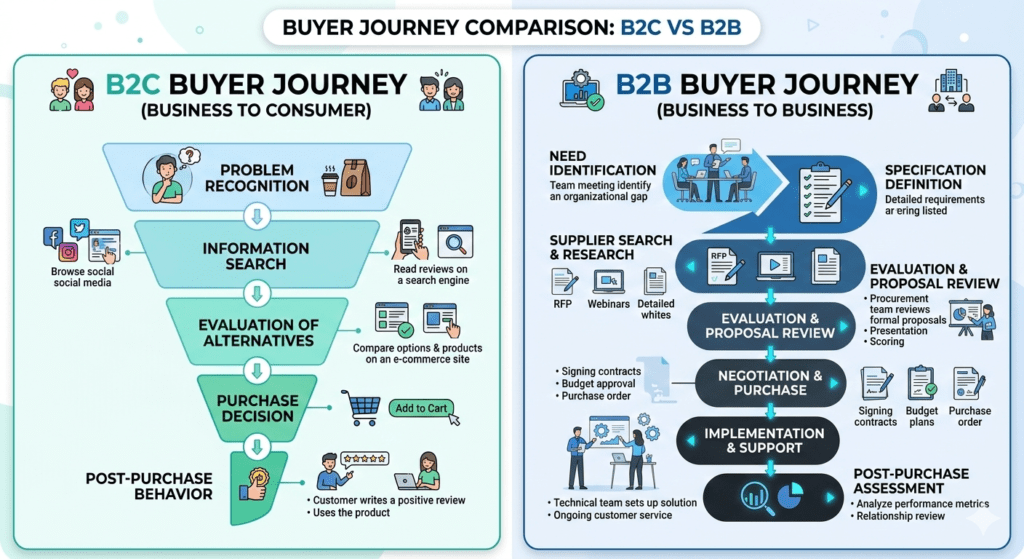
1. Deep Research: Understanding Your Buyers Beyond Demographics
Most B2B companies think they know their audience. They have basic demographics – industry, company size, job titles. They’re wrong about what matters.
Your target audience has dozens, sometimes hundreds, of different pain points influencing their search for solutions. Surface-level understanding generates surface-level results.
Effective B2B SEO requires deep buyer persona research and detailed journey mapping.
Questions That Actually Matter
Who are they really?
- Demographics (age, location, company type)
- Specific role and responsibilities
- Career background and experience level
- How they prefer to communicate (email, phone, LinkedIn)
- Where they get business information
What drives their decisions?
- Who else is involved in purchasing decisions?
- What are their specific business goals?
- What challenges keep them awake at night?
- What objections do they raise during sales conversations?
- How does your solution address their specific challenges?
What influences them?
- Which publications do they read?
- Which industry events do they attend?
- Who are the thought leaders they follow?
- What case studies resonate with them?
Why This Research Matters for SEO
This deep persona research directly influences your keyword targeting and content creation.
For B2C, you target generic keywords with high search volume: “running shoes,” “best laptop,” “cheap flights.”
For B2B, search volumes are incredibly low for bottom-funnel terms. You need to target audiences much higher in the funnel – people who don’t even know your solution exists yet.
Example:
B2C keyword: “CRM software” – 49,500 searches/month
B2B reality: Your target searches “how to improve sales team productivity” – 880 searches/month
The B2B keyword has 98% less volume but attracts buyers 6-9 months before they evaluate specific solutions. By the time they search “CRM software,” they’ve already created a shortlist – and you’re not on it because you weren’t there during their research phase.
Your buyer persona research reveals these early-stage problems and questions. That’s where your SEO strategy begins.
How to Actually Do This Research
Interview existing clients
Ask what they were searching for before they found you. What specific problems were they trying to solve? What content helped them understand solutions?
Survey your sales team
They hear objections, questions, and pain points daily. Document the exact language prospects use.
Monitor competitor content
What topics are your competitors covering? More importantly, what are they missing?
Use conversation intelligence tools
Record and analyze sales calls to identify recurring themes, questions, and concerns.
The goal: Create detailed buyer personas with enough specificity that your content directly addresses their actual concerns using their actual language.

2. Strategic Content Marketing: Volume Over Viral
B2C content strategy: Create one viral blog post that generates 50,000 visits.
B2B content strategy: Create 50 focused articles that each generate 200-1,000 visits from exactly the right people.
This fundamental difference catches most B2B companies by surprise.
Why B2B Content Needs Volume
Remember those low search volumes we discussed? “Improve sales team productivity” gets 880 monthly searches. “Reduce customer churn in SaaS” gets 320 searches. “Manufacturing supply chain optimization” gets 590 searches.
Individual pieces of B2B content will never drive massive traffic. But they reach precisely the decision-makers you need.
Your strategy: Cast a wide content net covering every issue your buyer personas face throughout their journey.
The B2B Content Formula
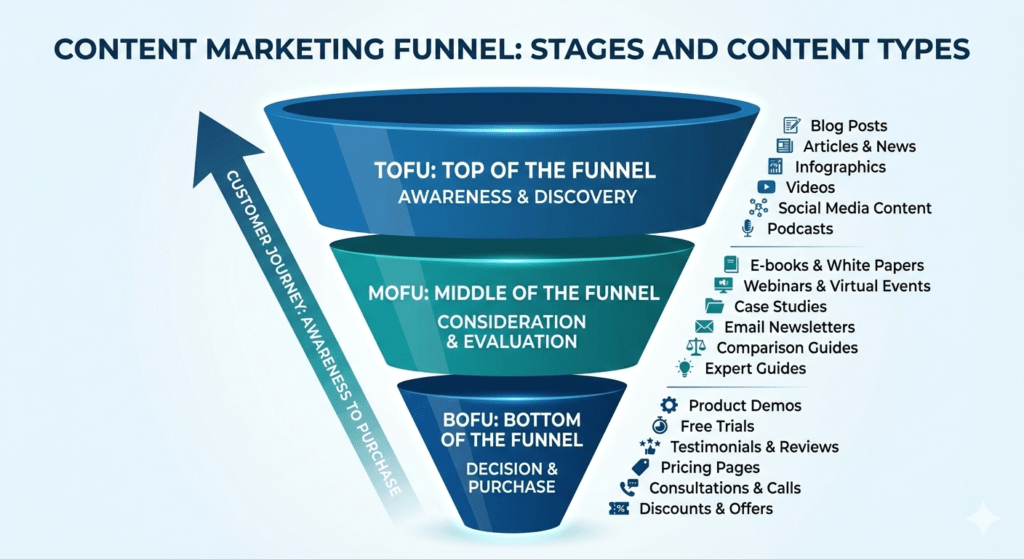
Map content to buyer journey stages:
Early Stage (Problem Awareness):
“5 Signs Your Sales Process Is Losing Deals”
“Why Manufacturing Costs Keep Rising (And What to Do About It)”
“The Hidden Cost of Manual Data Entry”
These articles attract people experiencing problems but not yet researching solutions.
Middle Stage (Solution Education):
“How Automation Reduces Manufacturing Costs”
“Sales Enablement Strategies That Actually Work”
“Guide to Choosing Supply Chain Management Software”
These help prospects understand solution categories and approaches.
Late Stage (Vendor Evaluation):
“[Your Solution] vs [Competitor]: Honest Comparison”
“How [Your Company] Helped [Client] Achieve [Result]”
“Pricing Guide: What [Your Solution] Actually Costs”
These support active evaluation and buying decisions.
Most B2B companies make one critical mistake: They only create late-stage content. Every article is “why choose us” or “our solution explained.”
The problem: By the time buyers reach late-stage research, they’ve already formed opinions based on early-stage content – content your competitors published.
Content Distribution Reality
For B2C businesses, 80% of leads come from bottom-funnel content (people ready to buy).
For B2B businesses, that ratio flips completely. If 10% of your leads are bottom-funnel, you’re performing well. Most B2B companies get only 5% bottom-funnel leads.
This means 90-95% of your leads need nurturing through education before they’re ready to buy. Your content must support this extended journey.
Quality vs Quantity Balance
You need volume, but not at the expense of quality.
Each piece should:
- Answer specific questions completely
- Demonstrate expertise and credibility
- Include data, examples, or case evidence
- Be written in clear, accessible language
- Lead naturally to next-step content
Thin, generic content doesn’t work even when you publish 100 articles. You need comprehensive, valuable content – just more of it than B2C businesses require.
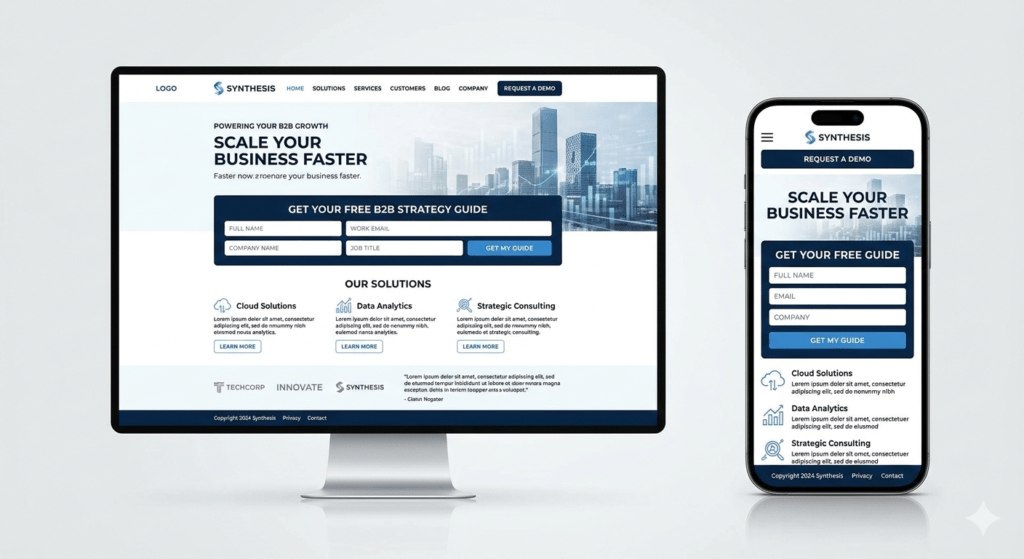
3. User Experience and Conversion Architecture
Having great content means nothing if visitors can’t find what they need or take next steps.
B2B SEO success depends on two critical factors most companies overlook:
Factor 1: Technical User Experience
Google increasingly prioritizes user experience as a ranking factor. Sites that load slowly, display poorly on mobile devices, or frustrate visitors with poor navigation lose rankings regardless of content quality.
What B2B sites need:
Fast page load times
Target under 2.5 seconds. B2B buyers are busy executives – they won’t wait.
Mobile optimization
67% of B2B research happens on mobile devices. If your site doesn’t work perfectly on phones and tablets, you’re invisible to two-thirds of your market.
Clear navigation
Visitors should find relevant information within 2-3 clicks. Complex site structures that hide important content behind multiple layers kill conversions.
Professional design
B2B buyers judge your company’s competence based on your website quality. Amateur design suggests amateur service.
Factor 2: Strategic Lead Capture
Because B2B sales cycles are lengthy, you need multiple conversion opportunities throughout the buyer journey.
Early-stage offers (build awareness):
- Industry reports and research
- Educational guides and ebooks
- Webinars and training sessions
- Assessment tools and calculators
Mid-stage offers (nurture consideration):
- Case studies and success stories
- Product comparison guides
- ROI calculators
- Free consultations
Late-stage offers (close deals):
- Free trials or demos
- Detailed pricing information
- Implementation planning sessions
- Pilot programs
Most B2B websites only offer late-stage conversions (“Request a Demo,” “Talk to Sales”). This captures the 5-10% ready to buy but loses the 90% still researching.
Why This Impacts SEO Rankings
Google tracks user behavior metrics:
- Time on page
- Pages per session
- Bounce rate
- Conversion actions
When visitors engage with your content and convert on offers, Google interprets this as high-quality content matching search intent. Rankings improve.
Research shows that aligning content to specific buyer journey stages yields 73% higher conversion rates. Better conversions signal better content to Google, creating a positive ranking cycle.
The formula:
Better UX → More engagement → More conversions → Higher rankings → More traffic → More conversions
If you nail user experience and conversion architecture, many other SEO factors matter less.
4. Thought Leadership and Authority Building
Here’s what most B2B companies miss: Your biggest SEO competitor isn’t another company selling your solution.
It’s the industry publications, research firms, and media sites that dominate informational search results.
When someone searches “supply chain optimization strategies,” they see:
- Forbes articles
- McKinsey research
- Industry trade publications
- Academic studies
Your company website? Nowhere.
Why This Matters
Remember that buyers spend 90-95% of their journey in research and education phases. If you’re invisible during this phase because you’re not competing for informational keywords, you’ve already lost.
The Authority Solution
Position your company as a thought leader – a source of valuable industry insights, not just a vendor selling solutions.
Create authority content:
Original research and data
Conduct surveys, analyze industry trends, publish findings. Original data earns links and citations.
Expert analysis and commentary
Respond to industry changes with informed perspective. Be the expert journalists quote.
Comprehensive guides
Create the definitive resource on topics relevant to your industry. The guide others link to.
Regular insights and updates
Maintain a content schedule that establishes you as an active thought leader, not a company that published a few articles once.
How to Build Authority That Ranks
Earn quality backlinks
When industry publications, educational institutions, and other authoritative sites link to your content, Google recognizes your expertise.
Publish consistently
Authority comes from demonstrated expertise over time, not isolated great articles.
Engage in industry conversations
Comment on industry news, participate in discussions, share insights on LinkedIn and industry forums.
Speak at industry events
Conference presentations establish credibility and generate authoritative backlinks from event websites.
Contribute to industry publications
Guest articles in respected publications build both authority and referral traffic.
This approach takes longer than traditional SEO tactics. But it creates sustainable competitive advantages that last years, not months.
Your competitors can copy your keywords. They can’t easily replicate three years of consistent thought leadership.

How to Implement B2B SEO Best Practices (Action Plan)
Understanding best practices means nothing without implementation. Here’s your step-by-step approach:
Month 1-2: Research Foundation
Week 1-2: Conduct buyer persona research
- Interview 5-10 existing clients
- Survey your sales team
- Document pain points, questions, objections
Week 3-4: Map buyer journeys
- Identify awareness, consideration, decision stages
- List information needs at each stage
- Define conversion goals for each stage
Week 5-6: Keyword research
- Identify keywords for each journey stage
- Prioritize based on relevance, not volume
- Map keywords to content topics
Week 7-8: Competitive analysis
- Audit competitor content strategies
- Identify content gaps and opportunities
- Document what’s working in your industry
Month 3-6: Content Development
Create 20-30 foundational articles:
- 40% early-stage (problem awareness)
- 40% mid-stage (solution education)
- 20% late-stage (vendor evaluation)
Develop conversion offers:
- 2-3 early-stage offers (guides, reports)
- 2-3 mid-stage offers (case studies, webinars)
- 2-3 late-stage offers (demos, consultations)
Optimize technical foundation:
- Improve site speed
- Ensure mobile optimization
- Implement clear navigation
- Set up conversion tracking
Month 7-12: Authority Building
Publish consistently:
- 2-4 new articles monthly
- Regular updates to existing content
- Quarterly comprehensive guides
Build industry presence:
- Submit to industry publications
- Speak at relevant events
- Participate in industry discussions
- Create original research
Monitor and refine:
- Track rankings for target keywords
- Measure conversion rates by journey stage
- Identify top-performing content
- Double down on what works
Measuring B2B SEO Success
Traditional SEO metrics (traffic, rankings) matter, but B2B requires different success measurements:
Lead quality over quantity
Would you rather have 100 unqualified leads or 10 qualified opportunities?
Pipeline contribution
How much pipeline value comes from organic search?
Sales cycle impact
Do leads from organic search close faster because they’re pre-educated?
Customer acquisition cost
Compare CAC for organic leads vs other channels
Long-term revenue
Track customer lifetime value from organic channel
Remember: B2B SEO generates results over months and years, not days and weeks. Measure accordingly.
Common B2B SEO Mistakes to Avoid
Even with best practices understood, companies make predictable mistakes:
Mistake 1: Expecting quick results
B2B SEO takes 6-12 months to generate meaningful results. Budget and expectations accordingly.
Mistake 2: Focusing only on product keywords
Your product name and category have minimal search volume. Target problems and questions instead.
Mistake 3: Neglecting early-stage content
If you only create “why choose us” content, you’re invisible during 90% of the buyer journey.
Mistake 4: Treating all leads equally
Early-stage leads need nurturing. Don’t send them immediately to sales.
Mistake 5: Giving up too soon
Many companies quit after 3-4 months seeing minimal results. That’s exactly when momentum builds.

Your Next Steps: Implementing B2B SEO
You now understand the 4 critical B2B SEO best practices:
- Deep buyer research – Understanding your audience beyond demographics
- Strategic content volume – Creating comprehensive content libraries
- Conversion architecture – Building UX and offers that capture leads at every stage
- Authority building – Positioning as industry thought leaders
The difference between B2B companies that succeed with SEO and those that fail isn’t understanding these practices. It’s actually implementing them consistently over time.
Start Here
Option 1: Self-Implementation
If you’re handling SEO internally:
- Download our B2B SEO checklist to track implementation
- Review our complete SEO guide for additional strategies
- Start with buyer persona research this week
- Create your first 10 content topics based on research findings
Option 2: Expert Guidance
If you want accelerated results:
- Schedule a free strategy session to discuss your specific situation
- Get a custom B2B SEO roadmap for your industry
- Identify your highest-ROI opportunities
- Develop an implementation plan aligned with your resources
The companies winning with B2B SEO in 2026 aren’t necessarily the biggest or most established. They’re the ones consistently executing these best practices while competitors continue using outdated B2C tactics.
Your buyers are searching. They’re researching solutions. They’re making decisions.
The only question: Will they find you, or your competitors?
Ready to Dominate Your Niche?
Stop guessing. Start growing with a custom SEO roadmap.
Claim Your Free SEO Audit →